A concept from the collection
Maya Bennett
Studio Practice — fictional brief Designed by the studio to a brief it wrote itself. The practice is fictional.
The site does not lower the threshold. It argues the threshold was pointing the wrong way.
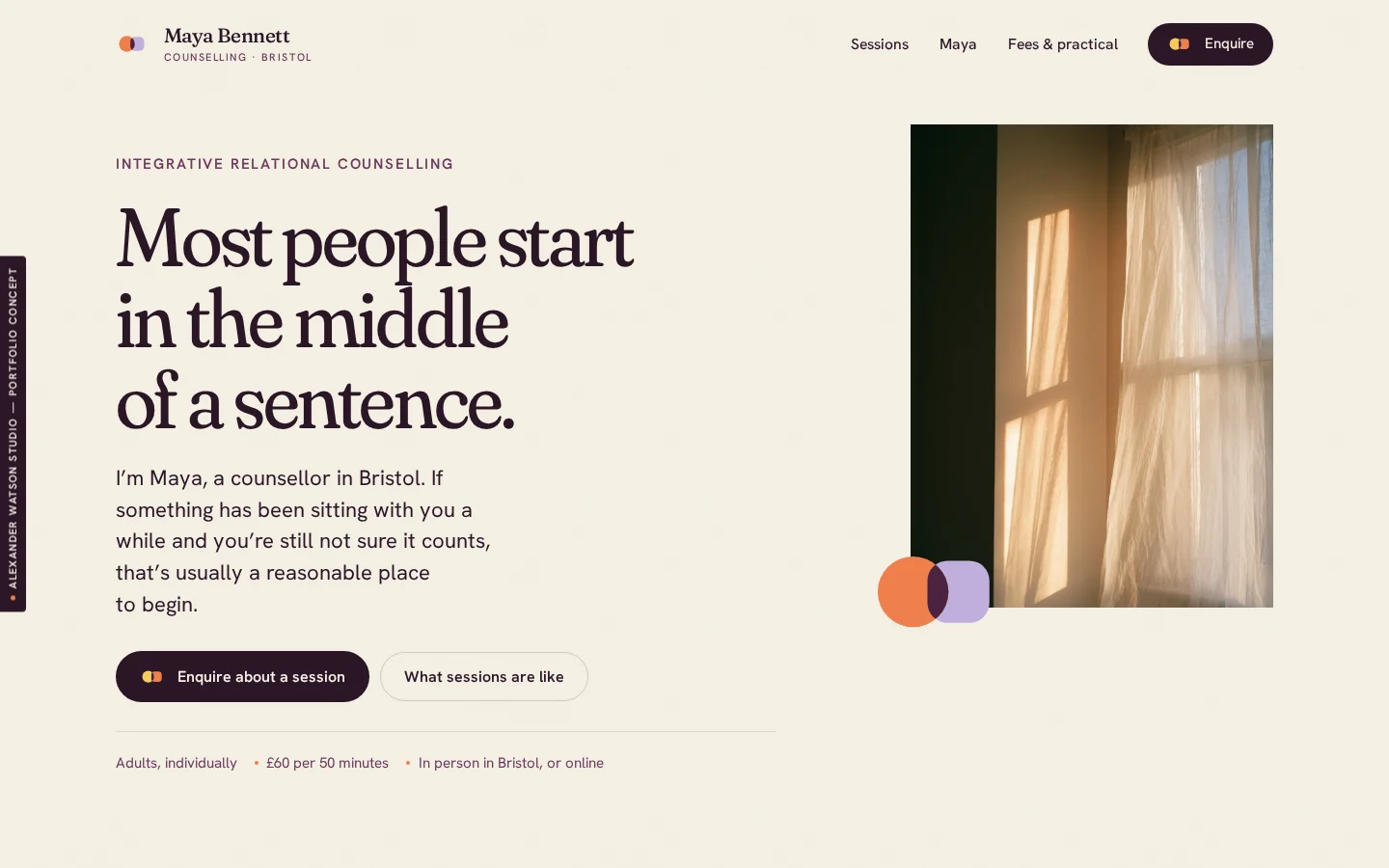
A complete concept website for a fictional integrative relational counsellor in Bristol and, published next to it, the strategic work that produced it. Every conclusion in the document sits beside the design decision it produced, so you can check the second against the first.
What was particular
Most people decide they are not entitled to this before they decide anything else.
Maya works with adults who are often not in crisis: the long, functional stretch where everything looks fine from the outside and very little is felt. Many of them are contacting a counsellor for the first time, and they arrive apologising: for not having a proper reason, for taking a place someone else might need more, for being upset about something they have already decided is small.
The strategic move is not reassurance. This practice holds that the polished account is the less useful one, because it has already been edited by the person who needs help with the editing. So the site removes the preconditions somebody invents before counselling feels legitimate (a beginning, a serious enough reason, the right words, a prepared account) and then argues that the unprepared version is better material to start from.
Thinking, then design
Every decision on the page can be pointed at.
The document sets each strategic conclusion beside the thing on the website that came out of it. That is the part worth checking: open the site in one tab and the document in another, and see whether the second actually explains the first.
- The headline is the reader, not the servicePeople arrive mid-thought, with no beginning to start from. The largest type on the page is “Most people start in the middle of a sentence.” It is a description of the reader’s state rather than a name, a service or a promise.
- Entitlement before anything elseThe second band, before any service copy, is a single claim: there is no threshold to cross first. Nothing is offered until the question of whether you are allowed to be here has been dealt with.
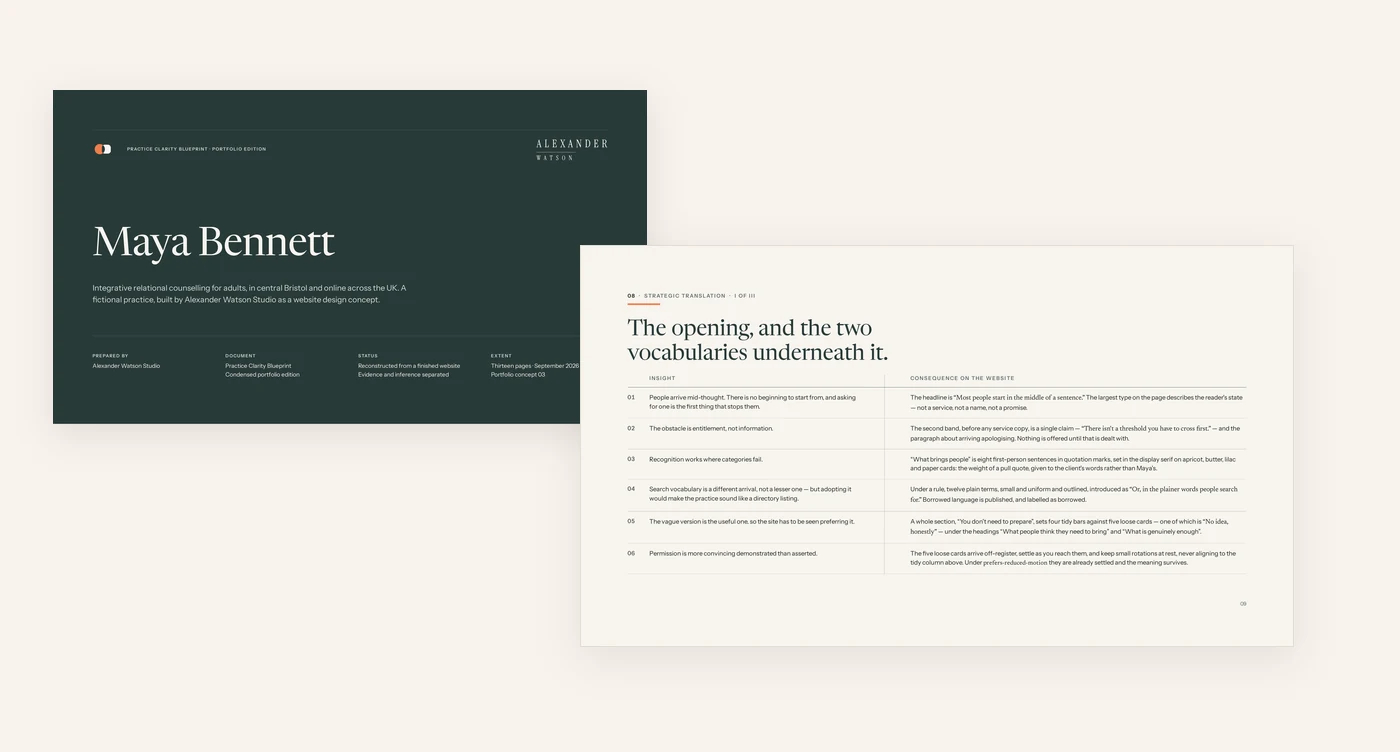
- Two vocabularies, neither one the price of admissionEight sentences people recognise, set large and on colour in the client’s own words. Then, under a rule, twelve plain search terms: small, uniform, and introduced as borrowed. The site publishes the search vocabulary without adopting it.
- The argument is demonstrated, not assertedA whole section sets four tidy bars against five loose cards, one of which is “No idea, honestly”. The loose ones sit off-register and stay there (nothing animates into place), so the untidy column never resolves into the tidy one above it.
- Nothing that has to be asked forEight practical questions are answered in a ledger before any contact is made, and the reduced fee can be requested without proving anything. The enquiry itself needs two fields and one badly-put sentence.
Read it
The thinking, in full.
Free to read, and explicit about its own footing throughout. Every page separates what the practice established from what the studio is interpreting and what it is recommending, and ends by saying which of the three the page rests on. It is the portfolio edition, and the last page says so.
PDF, 17 pages, about 1.0 MB. It opens in a new tab.
What is and is not being shown
Maya Bennett is not a real counsellor.
The practice, the room, the availability, the email address and the photographs are all invented for the concept. The five lines about training, membership, supervision and insurance are illustrative and deliberately unnamed: no professional body, course, registration number, supervisor or insurer is claimed, on the website or in the document. There are no testimonials and no outcomes, because inventing them would be dishonest rather than decorative.
The concept site says so on every screen and at every width, its credentials carry that note beside them, its enquiry form transmits nothing and says so, and it is kept out of search deliberately. Nobody can contact a counsellor who does not exist.
The crisis signposting on the concept site (Samaritans, NHS 111 and 999) is real and correct, because a fictional practice is a poor reason to publish a wrong helpline number.
Where to next
The other two are nothing like this one.
Maya is one of the three concept websites in the collection. The other two were built with the same method for practices with different problems, and arrive at different answers, which is the whole of what the collection is claiming.
Thinking about your own practice? Tell me about it