The Practice Clarity principles
Nine pieces on describing your own work.
Longer than the notes, and a set rather than a list of tips. This is the thinking every website here is built on, written down so you can apply it yourself without buying anything.
Free to read, and nothing on this page is the paid work. You do not have to read any of it to get a good website. It is here if putting the practice into words is the part that has stalled.

The pathway
Understand the practice, express it, then make the next step clear.
Three stages in the natural order of a good therapist website. Each contains three principles. Start at the beginning, or go straight to the decision in front of you.
Stage 1
Understand what the practice already communicates
Before promoting the work, notice what somebody encounters and what helps them stay.
Stage 2
Express it in a way the right person recognises
Make the work understandable and recognisably yours without turning it into a performance.
Stage 3
Connect the experience so the next step feels clear
Remove unnecessary complexity between a first impression and a genuine enquiry.
Three worked examples
What it looks like when all nine are applied to three very different practices.
Sofia Marin, Maya Bennett and Daniel Mercer are fictional practices with finished concept websites. The strategic work behind each is published in full, set out so that every conclusion sits beside the design decision it belongs to, which is the only honest way to show that the thinking does any work. The three sites have almost nothing in common, which is rather the point.
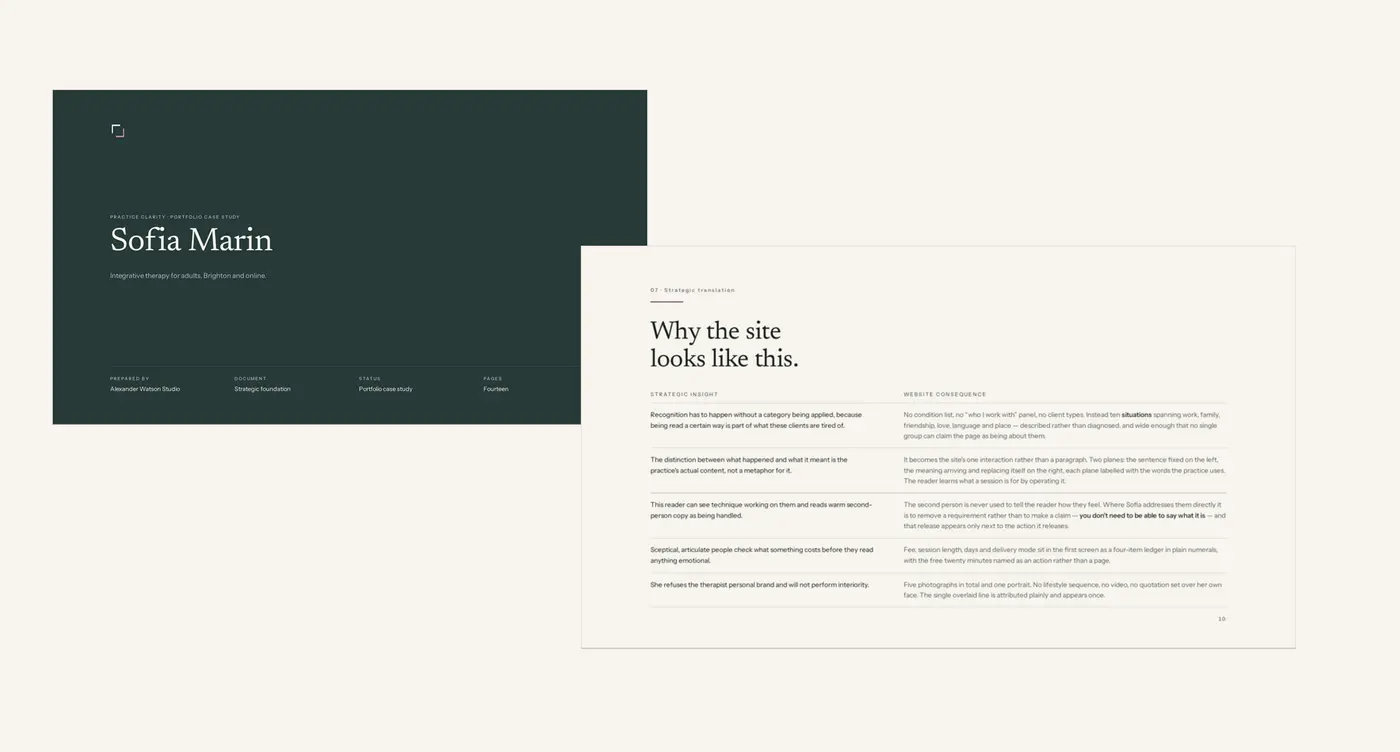
Sixteen pages, free to read, and set out as the document a practice reviews before any design work: it settles how the practice should be described, then turns that into creative direction. Every page ends by naming what it rests on: what was established, what is being interpreted, and what is being recommended.
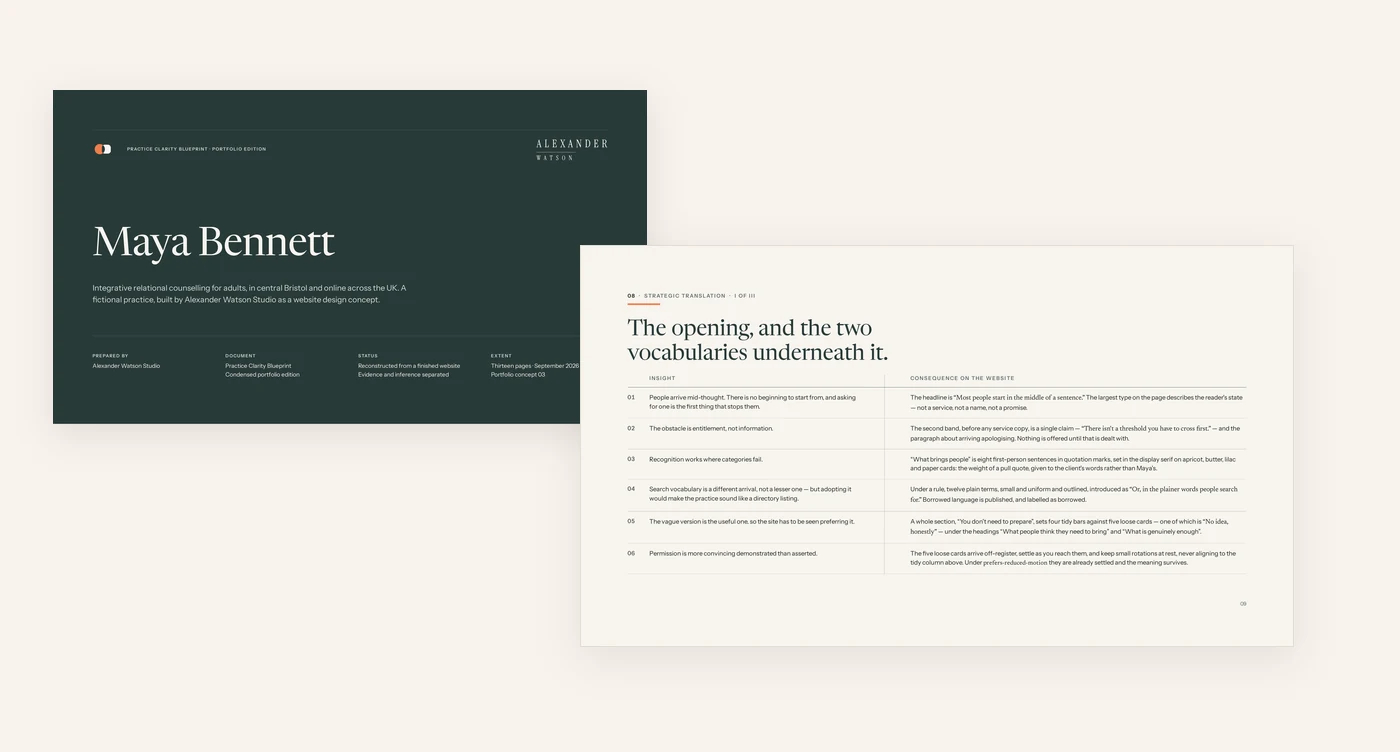
Seventeen pages, and the same discipline applied to a practice with an entirely different argument: that people invent preconditions before counselling feels legitimate, and that whatever version somebody has now is enough to begin with.
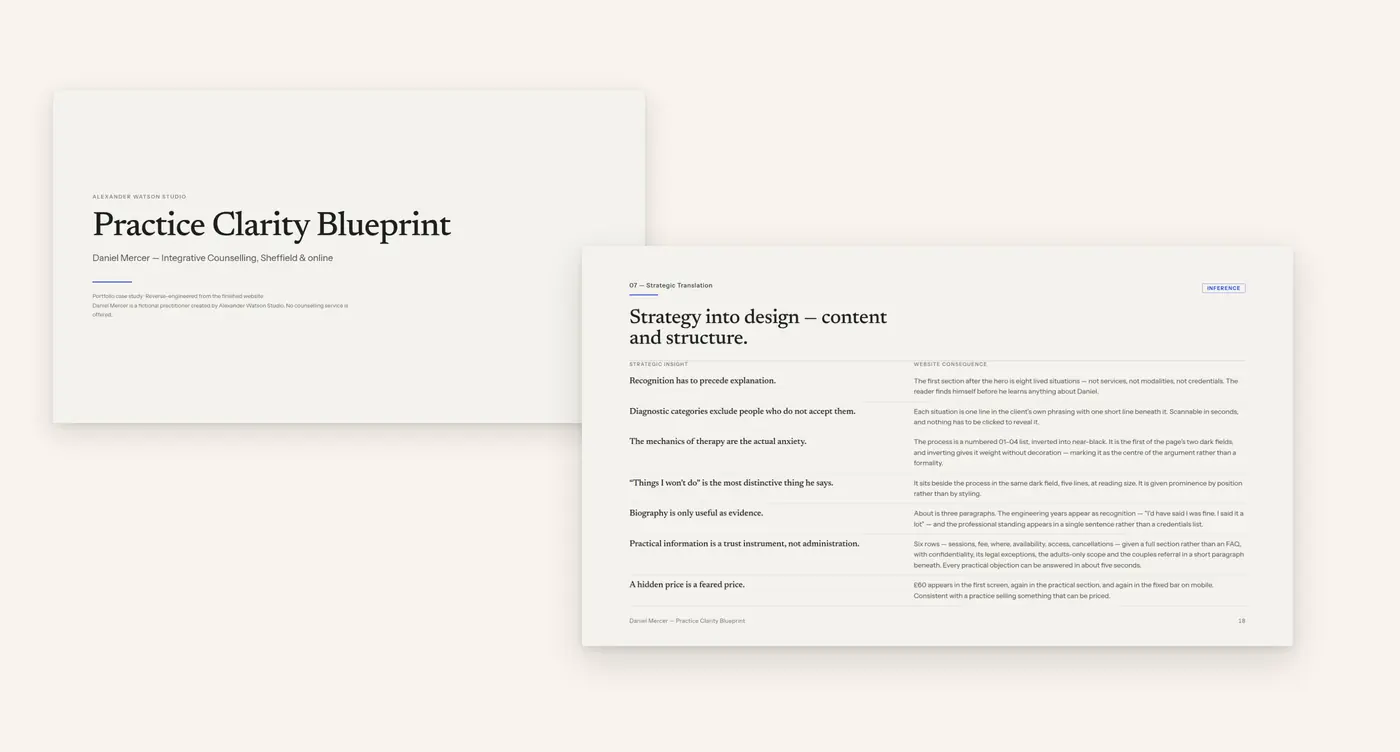
Sixteen pages, and the same discipline applied to a practice whose argument is about the threshold: that the reader has decided he would be bad at therapy, and that the site’s job is to remove the entry requirement rather than promise a result. It asks the design to carry no atmosphere at all, so that everything the visitor is meant to feel arrives as information.
These are portfolio concepts, not client case studies. A client receives the same kind of document, written for their practice and agreed before anything is designed. The three shown here were written after their concept sites, in the form a client’s is written before one.
A clearer next step
You do not need to market more loudly.
If reading these is enough, good. If you would rather I worked it out with you and wrote it down for your practice, that is part of what a website costs here, included in the £495 rather than sold beside it. That is the price for the first three practices; £995 after them, with the same work inside it.