A concept from the collection
Daniel Mercer
Studio Practice — fictional brief Designed by the studio to a brief it wrote itself. The practice is fictional.
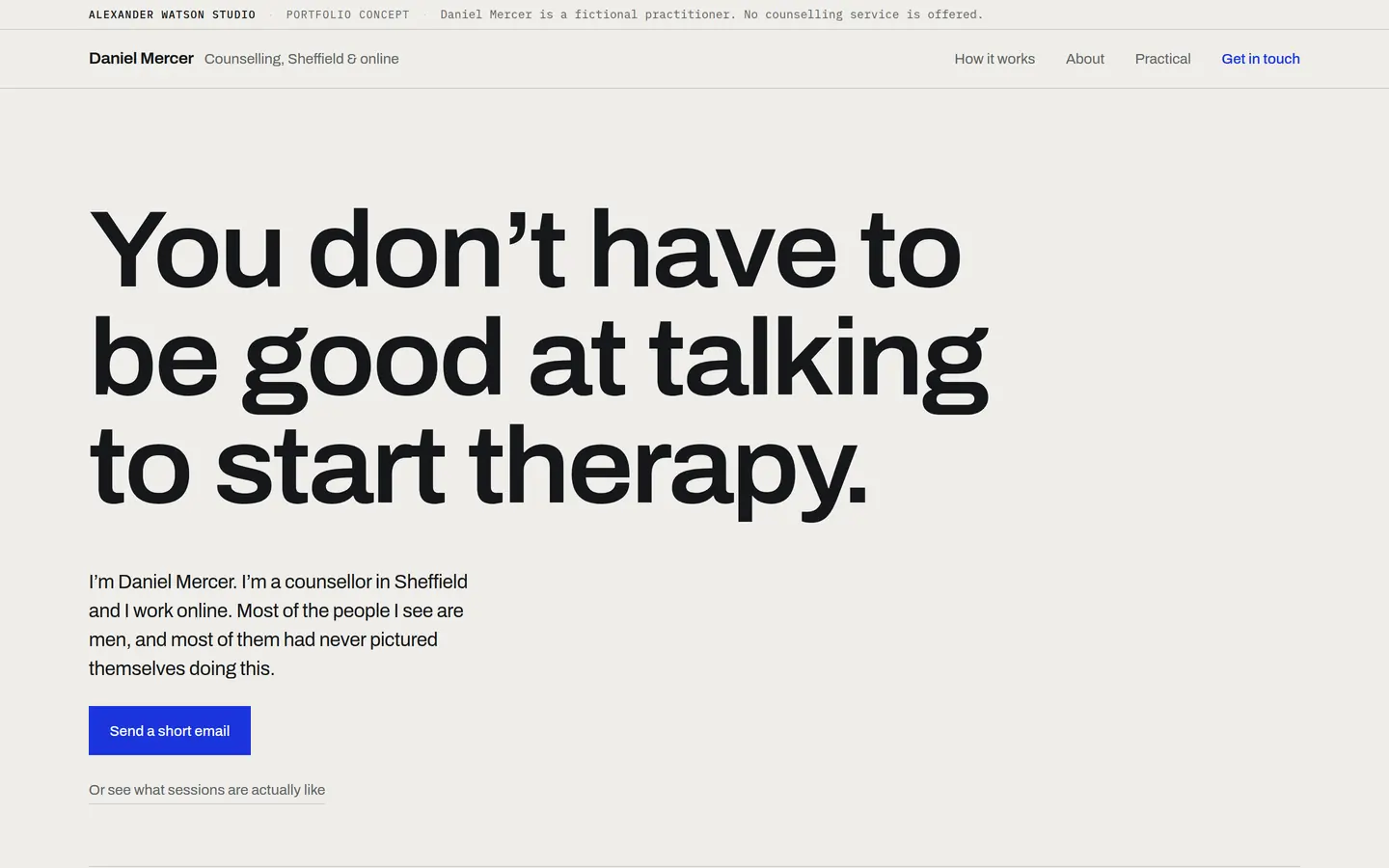
Most therapist websites promise an outcome. This one removes an entry requirement: the belief that you have to be good at talking before you are allowed to start.
A complete concept website for a fictional integrative counsellor in Sheffield and, published next to it, the strategic work that produced it. Every conclusion in the document sits beside the design decision it produced, so you can check the second against the first.
What was particular
Still working, still coping, and fairly sure this is not for people like them.
Daniel works with adults who are still parenting, still earning and rarely in crisis, at the point at which a way of coping that has worked for years quietly stops working. Most of them are men, most have never pictured themselves doing this, and a good number were prompted by somebody else. They do not arrive thinking they are unwell. They arrive thinking there is a vocabulary they do not have and a performance they would fail.
That assumption, rather than the difficulty itself, is what keeps them out, so the barrier the site has to remove is the cost of beginning. It never asks the reader to explain their problem, answers each fear with a fact instead of a reassurance, and puts the fee, the room, the process and the limits in the open where a competing site would put atmosphere. The design is ordinary on purpose: the conventional therapy aesthetic is itself part of what this reader has already declined.
Thinking, then design
Every decision on the page can be pointed at.
The document sets each strategic conclusion beside the thing on the website that came out of it. That is the part worth checking: open the site in one tab and the document in another, and see whether the second actually explains the first.
- The headline removes a requirement rather than promising a resultThe reader believes therapy is a skill he does not have. So the largest thing on the page is eleven words that retire the belief: “You don’t have to be good at talking to start therapy.” It promises nothing, which is why the site can afford to be specific about the first email and unpromising about results.
- Situations, before services or credentialsA person who does not accept a diagnostic category cannot recognise themselves in one. The first section after the hero is eight lived situations in the client’s own phrasing: anger arriving faster, anxiety managed for years, “getting on with it” no longer working. No conditions, no modalities, nothing to click to reveal.
- The mechanics printed, not protectedTo this reader the mechanics of therapy are the anxiety. £60 for fifty minutes sits in the first screen; the process is four numbered steps inverted into near-black; six practical rows give sessions, fee, place, availability, access and cancellations, with confidentiality and scope written as content rather than small print.
- The refusals, stated as refusals“Things I won’t do” is five lines, at reading size, given prominence by position rather than styling. It ends with the one that prices the practice: “Stay quiet when I think something matters. That part is most of what you’re paying for.”
- An enquiry that asks for almost nothingRequiring a written problem statement would undo everything else on the page. The form asks for a name and an email address; the message field is optional and says “Three lines is plenty. Or leave it blank.”

Read it
The thinking, in full.
Free to read, and explicit about its own footing throughout. Every page separates what the practice established from what the studio is interpreting and what it is recommending, and ends by saying which of the three the page rests on. It is the portfolio edition, and the last page says so.
PDF, 16 pages, about 165 KB. It opens in a new tab.
What is and is not being shown
Daniel Mercer is not a real counsellor.
Daniel Mercer is a fictional practitioner created by Alexander Watson Studio to demonstrate a website direction. No counselling service is offered. The practice, the room, the fee, the availability, the email address and the photographs are all invented for the concept. The one sentence about professional standing (registered, insured, in supervision) is deliberately unnamed: no professional body, registration number, course, supervisor or insurer is claimed, on the website or in the document. There are no testimonials and no outcomes, because inventing them would be dishonest rather than decorative.
The concept site names the Studio and the words “portfolio concept” above its own header at every width, before the headline can be read. Its enquiry form cannot transmit anything and says so, the address uses the reserved .example domain, and it carries no business or healthcare structured data and is kept out of search deliberately. Nobody can contact a counsellor who does not exist.
The crisis signposting on the concept site (a GP, NHS 111 and Samaritans) is real and correct, because a fictional practice is a poor reason to publish a wrong helpline number.
Where to next
The other two are nothing like this one.
Daniel is one of the three concept websites in the collection. The other two were built with the same method for practices with different problems, and arrive at different answers, which is the whole of what the collection is claiming.
Thinking about your own practice? Tell me about it