A concept from the collection
Sofia Marin
Studio Practice — fictional brief Designed by the studio to a brief it wrote itself. The practice is fictional.
Her clients are tired of being read accurately. So the site describes nobody, and hands them the method instead: one sentence that never changes, and the meanings underneath it that do.
A complete concept website for a fictional integrative therapist in Brighton, published next to the strategic work that produced it, and next to the identity developed from it. Like every concept in the collection, the reasoning is published so you can go and check it against the page.
What was particular
Competent, articulate, and wary of being described.
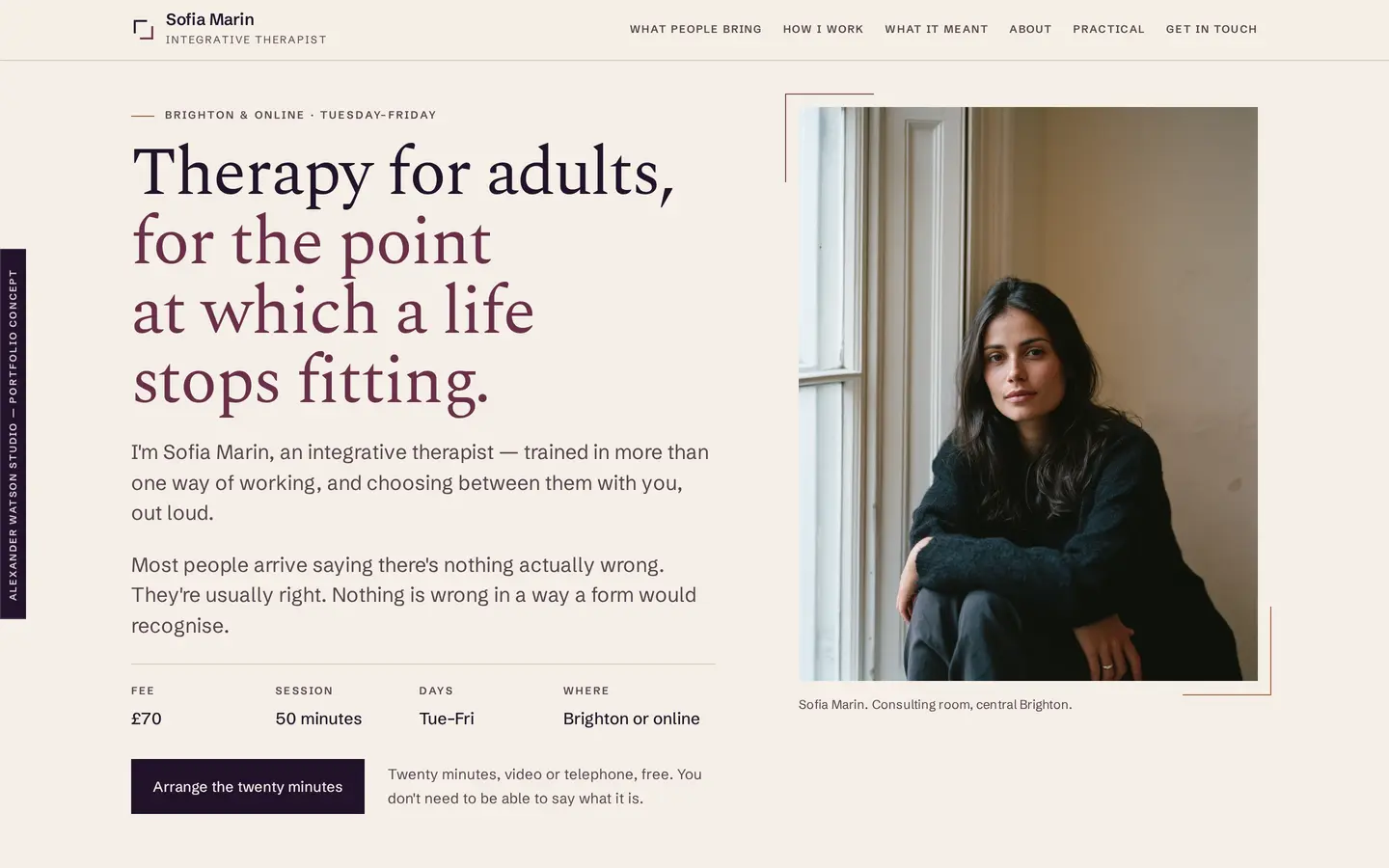
Sofia works with adults whose lives are working and no longer feel like theirs. They have been read a certain way by other people for years and are tired of it, which rules out most of what a therapy website normally does. No condition list. No “who I work with” panel. No warm second-person copy telling a reader how they feel.
So the site describes situations rather than people, and puts the fee, the session length, the working days and the introductory conversation in the first screen, before any feeling is asked for. Its one interactive element is the practice’s own method: a sentence that stays fixed while the meanings beneath it are re-read. A visitor learns what an hour with her is for by operating it, rather than by being told.
Thinking, then design
Every decision on the page can be pointed at.
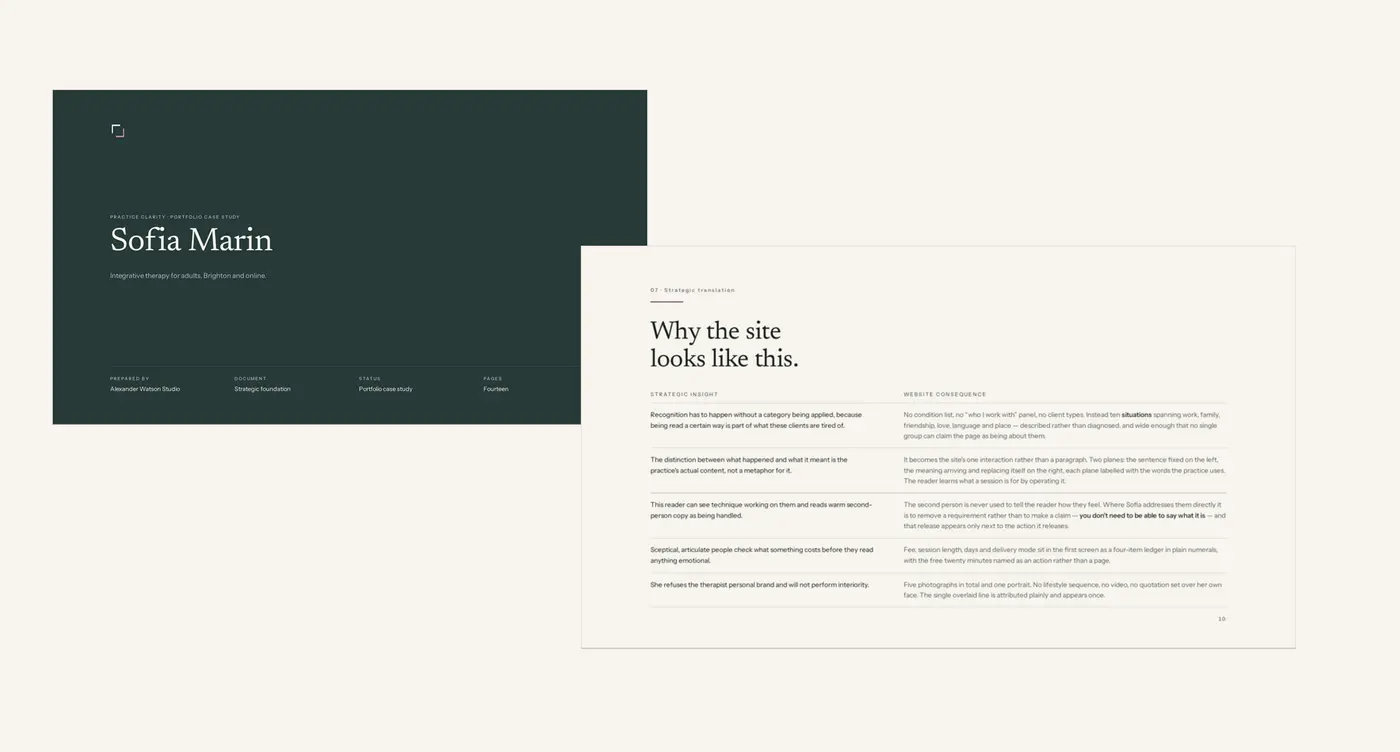
The document sets each strategic conclusion beside the thing on the website that came out of it. That is the part worth checking: open the site in one tab and the document in another, and see whether the second actually explains the first.
- No condition listBeing read a certain way is part of what these clients are tired of, so the page names no conditions and no client types. Ten situations instead, described rather than diagnosed, and wide enough that no single group can claim the page is about them.
- The fee, firstSceptical people check what something costs before they read anything emotional. Fee, session length, working days and delivery sit in the first screen as four plain numbers.
- One interactionThe practice is about the distance between what happened and what it turned out to mean. That is the site’s only interactive element rather than a paragraph describing it: the sentence fixed on the left, the meanings arriving on the right.
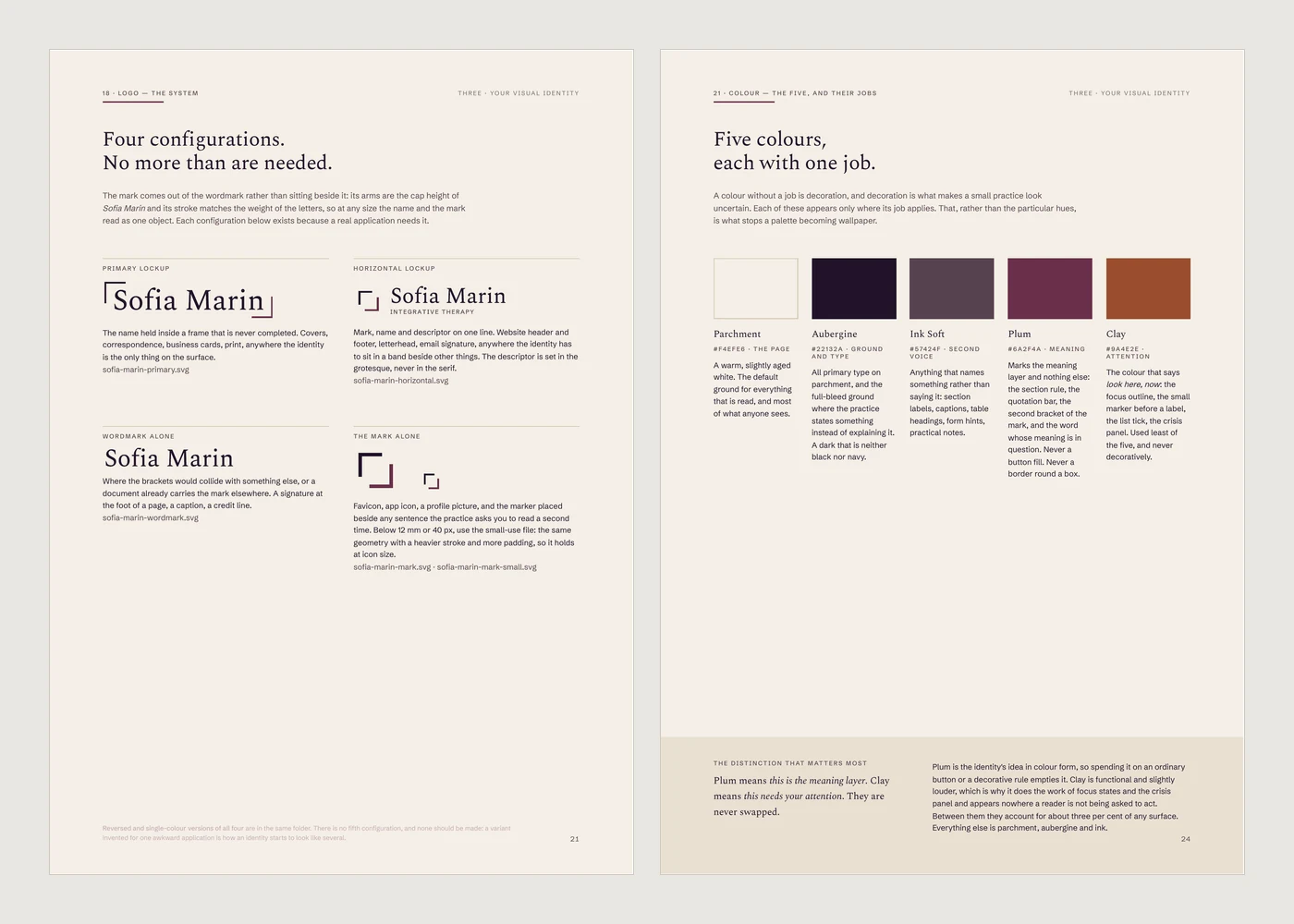
- Colour with a jobColour used as mood would contradict a practice built on precision. Plum marks the meaning layer and the identity mark that stands for it, and never a button, a navigation state or a form.
- The awkward facts, out loudThe first floor and the absent lift, the late-cancellation charge and the reply that may not come until the next working day are written as content, in her own voice, rather than as small print.
Read it
The thinking, in full.
Free to read, and explicit about its own footing throughout. Every page separates what the practice established from what the studio is interpreting and what it is recommending, and ends by saying which of the three the page rests on. It is the portfolio edition, and the last page says so.
PDF, 16 pages, about 270 KB. It opens in a new tab.
How far the identity can go
The website is one implementation of this.
The document defines the practice. The website is one implementation of it, and the most visible, but not where the decisions were made, and not the only place the practice will need them. A designer who had never spoken to her could work from this and build something else entirely.
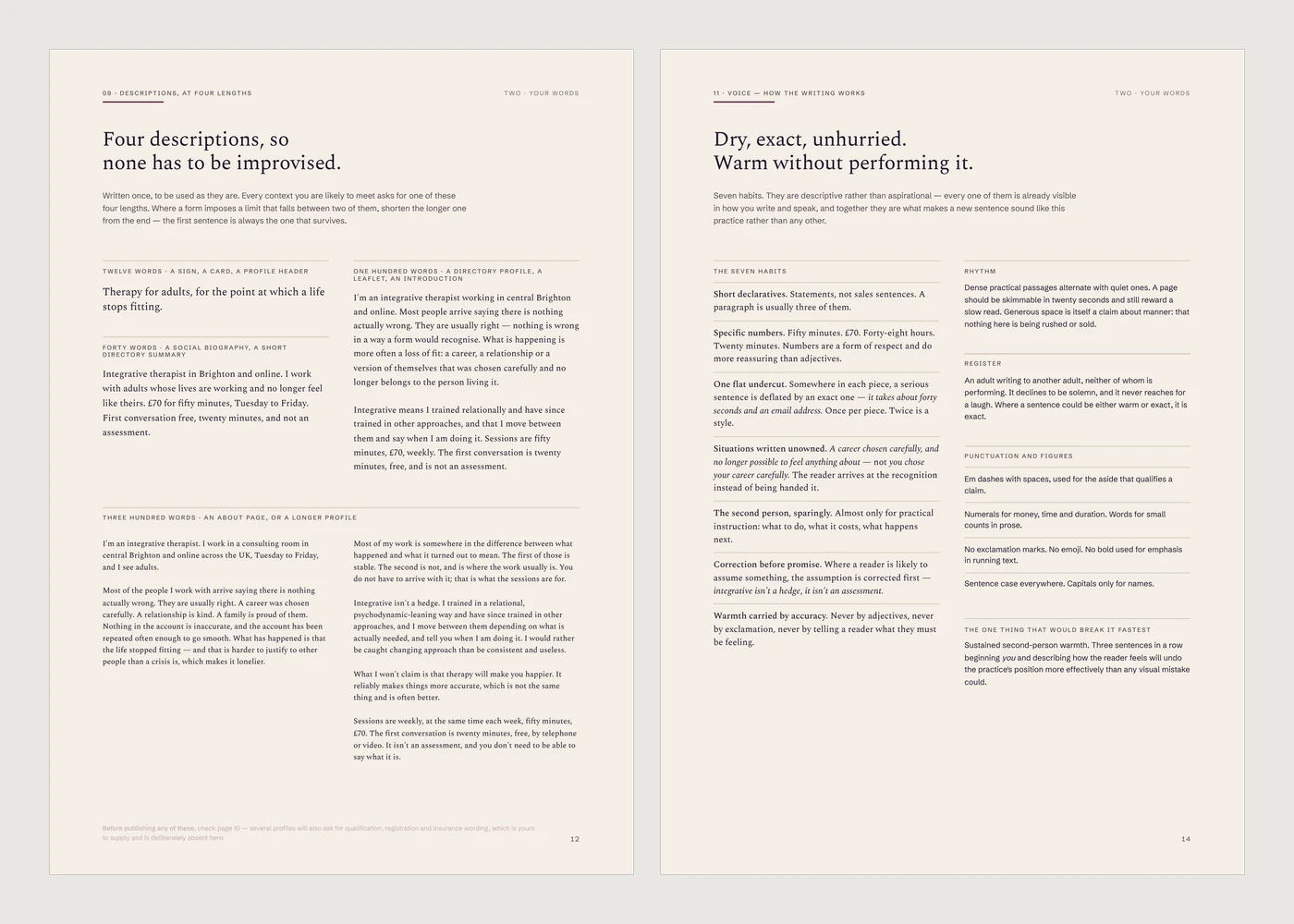
The practice, the words and the visual system in one document: what the practice stands for, how to describe it at the lengths a profile or a leaflet actually asks for, the vocabulary that fits it, the logo, colour and typography decisions with the reason for each, how to use the identity online and in print, and a page of facts deliberately left blank because only the practitioner can supply them.
In Sofia’s guide
- The position, and the practice described at four usable lengths
- The voice: its habits, its vocabulary, and the language it avoids
- The wordmark, in the formats a printer, a sign maker and a developer each need
- Colour specified for screen and for print, with the contrast measured
- Typography specified, with the font files themselves
- A letterhead, an email signature and a business card
- Briefs to forward to a printer, a sign maker, a designer or a developer
Not in it
- An open-ended set of designed applications
- Print production, or the cost of printing
- Photography, illustration or social-media design
Read it
- Practice Identity Guide: PDF. It opens in a new tab.
- Published in full, like the thinking that came before it.
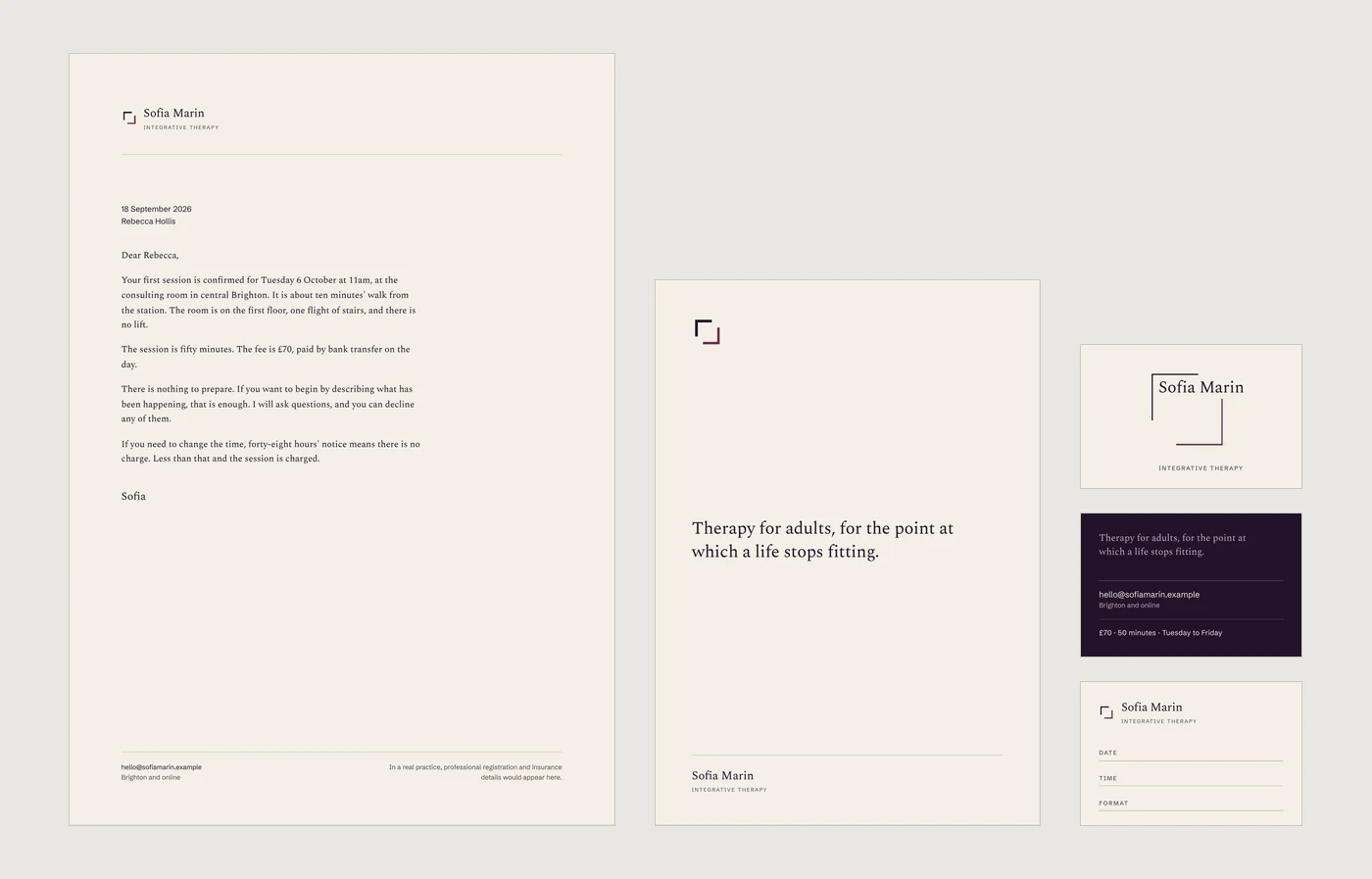
Sofia Marin is a fictional practice, so the identity is a demonstration rather than a commission, and it was taken further than most therapist websites need. A project covers the visual direction its website needs (typography, colour and how the name is set), and what a client keeps is set out on the cost page.
What the website does
Booking, built into the page.
The first step with Sofia is a twenty-minute conversation, reserved with a £10 payment. On most therapist websites that would mean a link to a separate booking site in somebody else’s colours. Here it happens in the page: the free times appear, a visitor chooses one, leaves their details and pays by card, in the same typefaces and the same plum as everything around it.
The payment runs through Stripe, an established payment provider, and on this concept it runs in Stripe’s test mode: you can go all the way through with a test card and no money moves. Card details go to Stripe and never pass through the website. The times offered are the practice’s own availability, and a time that has been reserved is no longer offered to anybody else.
For a real practice the same thing is built on top of the Practice Identity & Website when the practice needs it, scoped and quoted in writing, with the booking and payment accounts in your own name so that what a client pays goes to you. A practice that already uses Calendly or another system can usually keep it. What can be built, and how it is agreed.
Test mode means nothing is charged and no real card is needed: Stripe publishes test card numbers for exactly this purpose.
What is and is not being shown
Sofia Marin is not a real therapist.
The practice, the address, the email address and the photographs of the room are all invented for the concept. No professional registration, qualification, insurance, testimonial or clinical claim appears anywhere in the document or on the website, because inventing one would be dishonest rather than decorative.
The concept site says so on every screen, and it is kept out of search deliberately. Its booking runs in Stripe’s test mode, so a time can be chosen and the payment step completed with a test card, and no money moves; the email address shown on the site is not real. Nobody can contact a therapist who does not exist.
The crisis signposting on the concept site (Samaritans, NHS 111 and 999) is real and correct, because a fictional practice is a poor reason to publish a wrong helpline number.
Where to next
The other two are nothing like this one.
Sofia is one of the three concept websites in the collection. The other two were built with the same method for practices with different problems, and arrive at different answers, which is the whole of what the collection is claiming.
Thinking about your own practice? Tell me about it