A worked example
Helen Calder
Studio Practice — fictional brief Designed by the studio to a brief it wrote itself. The practice is fictional.
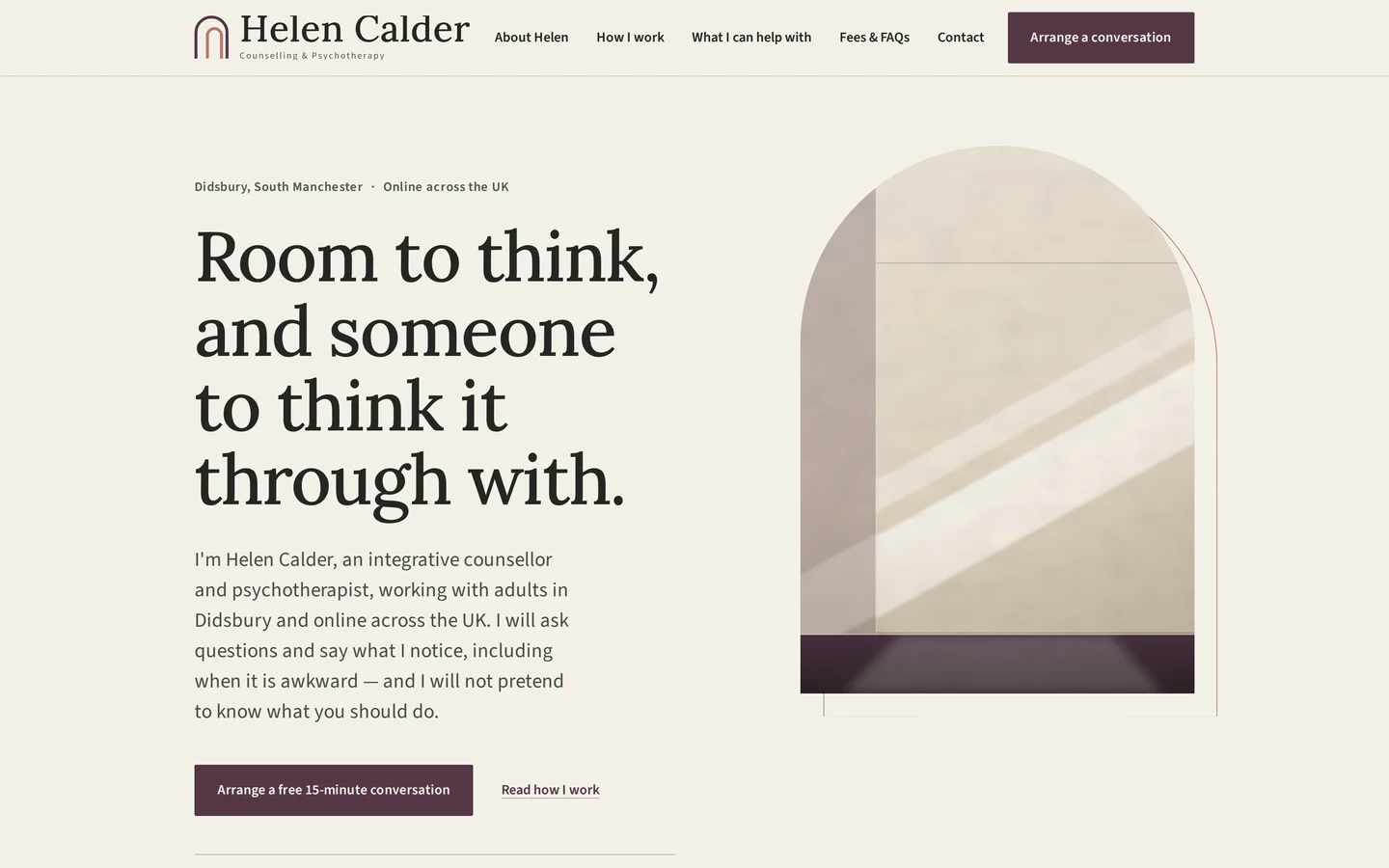
Her clients have already spent years thinking about this alone. So the site’s whole job is to say what she will actually do in the hour — and to be equally clear that the conclusions stay theirs.
A complete concept website for a fictional integrative counsellor in Didsbury — and, published next to it, the strategic work that produced it. Every conclusion in the document sits beside the design decision it produced, so you can check the second against the first.
What was particular
They had not stopped at whether to have therapy. They had stopped at which person.
Helen sees individual adults weekly, twelve years in practice, £65 a session. The people who find her are capable and privately worn out: they have carried something for years, considered therapy for almost as long, and got as far as choosing a name from a directory. What they still do not know is what any particular therapist will do with the hour.
They are wary in two opposite directions at once — of being told what to do by a stranger, and of paying to carry on thinking alone. Most therapist websites answer only one of those, and reassure their way past the other. This one answers both in the same paragraph: she will ask, notice, slow things down and name the thing that does not match, and she will not tell anyone what to do about their life. The case is therefore not about warmth or trust in the abstract. It is about making the therapist’s role legible before anyone has to book anything.
Thinking, then design
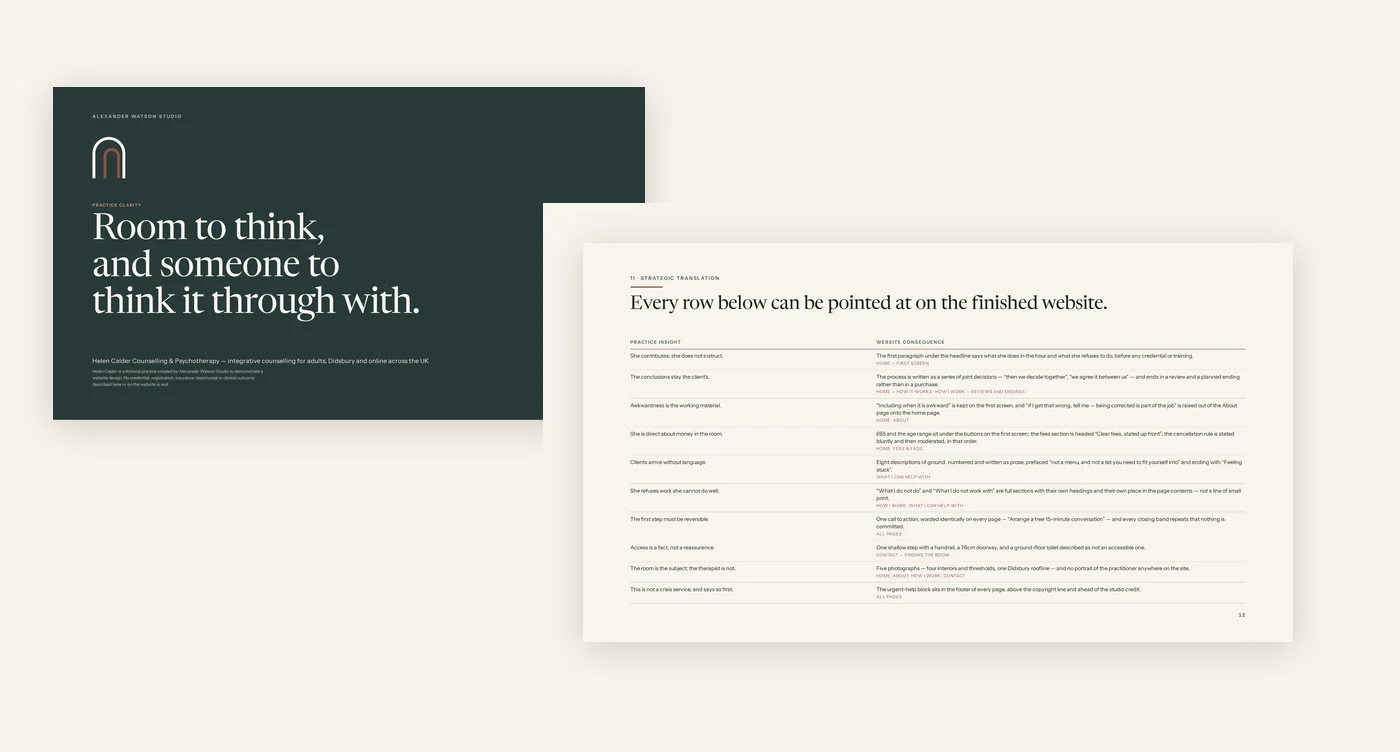
Every decision on the page can be pointed at.
The document sets each strategic conclusion beside the thing on the website that came out of it. That is the part worth checking: open the site in one tab and the document in another, and see whether the second actually explains the first.
- She contributes; she does not instructThe first paragraph under the headline says what she does in the hour and what she refuses to do — before any credential, training or philosophy. A reader deciding between two therapists is given the one thing a directory listing never contains: the job description.
- The conclusions stay the client’sThe process is written as a series of joint decisions — “then we decide together”, “we agree it between us” — and it ends in a review and a planned ending rather than in a purchase. Shared authorship is a structure on the page, not an adjective.
- Awkwardness is the working material“Including when it is awkward” is kept on the first screen, and “if I get that wrong, tell me — being corrected is part of the job” is raised out of the About page onto the home page. The reader is told they may overrule her before they are asked for anything.
- Directness about money is conduct, not convenience£65 and the age range sit under the buttons on the first screen; the fees section is headed “Clear fees, stated up front”; the cancellation rule is stated bluntly and then moderated, in that order. How she handles the awkward subject is itself evidence of how she behaves in the room.
- Clients arrive without languageEight descriptions of ground, numbered and written as prose, prefaced “not a menu, and not a list you need to fit yourself into” and ending with “Feeling stuck”. Lived situations rather than diagnostic sorting, because sense-making is the work rather than the entry fee.
- The first step has to stay reversibleOne call to action, worded identically on every page — “Arrange a free 15-minute conversation” — and every closing band repeats that nothing is committed. For someone who has deliberated for years, the obstacle is irreversibility rather than information.
- The room is the subject; the therapist is notFive photographs — four interiors and thresholds, one Didsbury roofline — and no portrait of the practitioner anywhere on the site. Access is given as fact rather than reassurance: one shallow step with a handrail, a 76 cm doorway, and a ground-floor toilet described as not an accessible one.
Read it
The thinking, in full.
Free to read, and it separates evidence from inference throughout: what the site actually says is quoted and attributed, and every conclusion drawn on top of it is marked as an inference the reader is free to reject. One page is given over to what this practice is not, which is the fastest way to see the argument doing work. It is a portfolio case study rather than the written Practice Direction a commissioned practice receives.
PDF, 14 pages, about 130 KB. It opens in a new tab.
What is and is not being shown
Helen Calder is not a real counsellor.
Helen Calder is a fictional practitioner created by Alexander Watson Studio to demonstrate a website direction. No counselling service is offered. The practice, the consulting room, the fee, the availability, the email address and the photographs are all invented for the concept. No real professional body is claimed: the site says registration is with the appropriate professional body for the discipline, names none, and states plainly that no registration number exists because the practitioner does not. There are no testimonials and no outcomes, because inventing them would be dishonest rather than decorative.
The concept site names the Studio and the words “portfolio concept” on every page, its enquiry route cannot reach a real person, and the email address uses the reserved .example domain. Nobody can contact a counsellor who does not exist.
The urgent-help block on the concept site — a GP, NHS 111 and Samaritans — is real and correct, because a fictional practice is a poor reason to publish a wrong helpline number.
Where to next
The directions you can actually start from.
Helen is a case study rather than one of the directions in the collection. If you are choosing a starting point for your own practice, that is what the collection is for.