A worked example
Harbour
Studio Practice — fictional brief Designed by the studio to a brief it wrote itself. The practice is fictional.
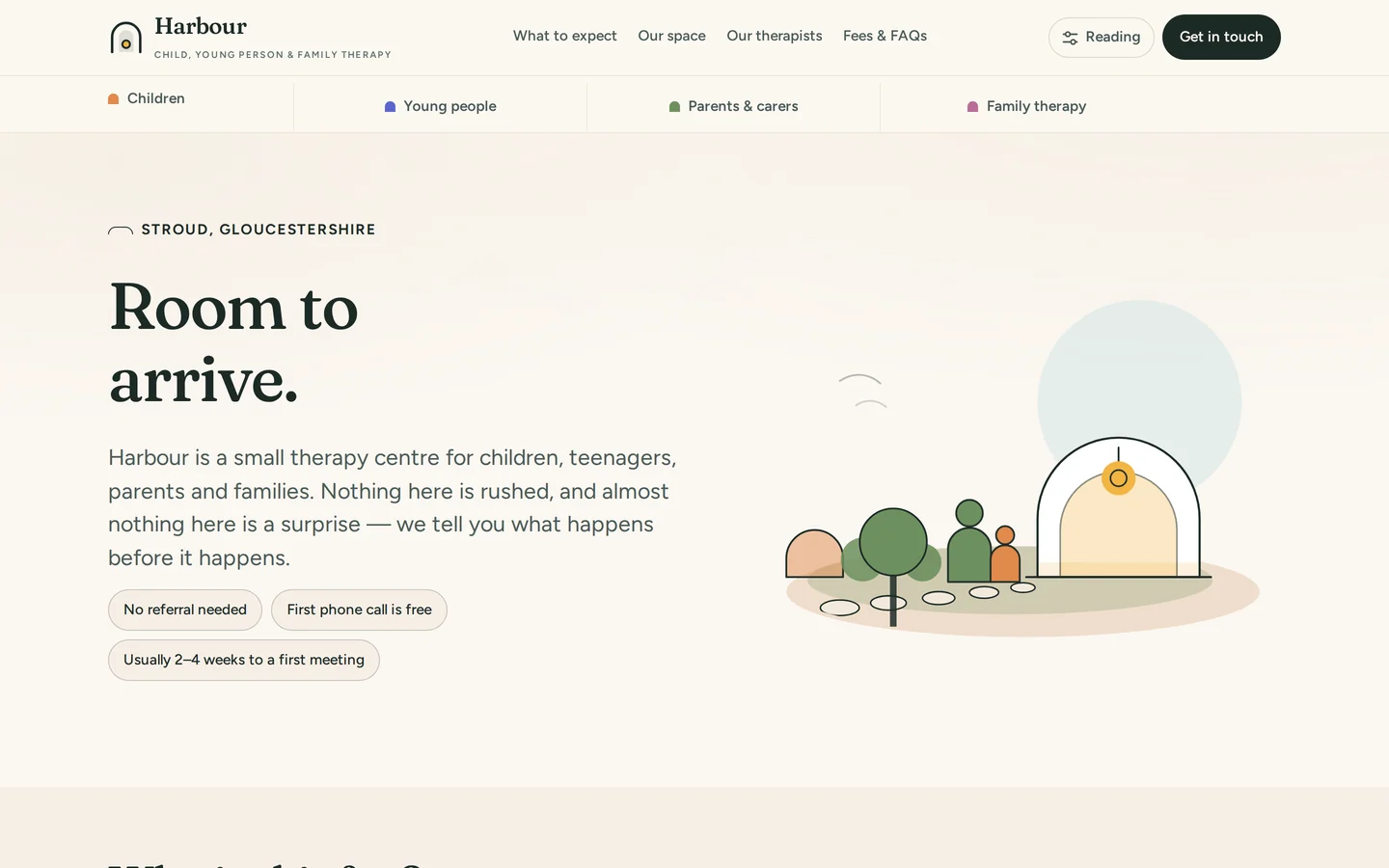
Harbour’s proposition is the removal of ambush: nothing arrives without notice, and almost nothing proceeds without your say-so.
A complete concept website for a fictional child, young person and family therapy centre in Stroud — and, published next to it, the strategic work that produced it. Every conclusion in the document sits beside the design decision it produced, so you can check the second against the first.
What was particular
Four readerships, one building, and two entirely different fears.
Harbour is five people and one building, working with children of about four to eleven, teenagers, parents and carers, and whole families. Those four readers need contradictory things and arrive holding different first questions. Children and young people are frightened of exposure — of being discussed, or of something they said being passed on. Parents and families are frightened of judgement and then exclusion. A single reassuring tone would fail all four, which is why the site routes before it describes anything at all.
The centre’s own view is that the frame around therapy — the same hour, held firmly at both ends, private enough for honesty — is not administration around the work but the active ingredient in it. That makes the website the first instalment of the frame rather than marketing about it. So it answers sequence and cost together, maps who will be told what, and describes the building down to the smell of the hallway. The trust it asks for is paid for with disclosure that costs something: no lift, thirteen stairs, and roughly one call in six referred somewhere else.
Thinking, then design
Every decision on the page can be pointed at.
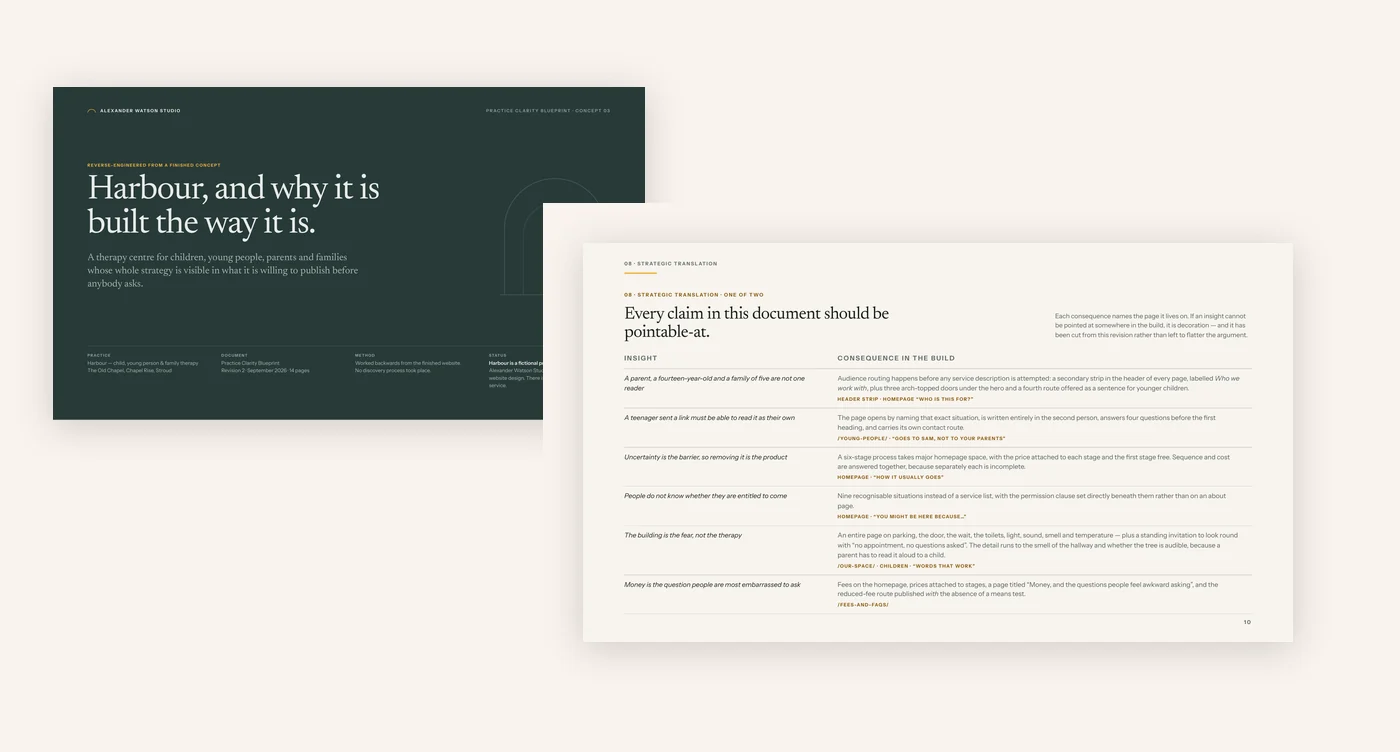
The document sets each strategic conclusion beside the thing on the website that came out of it. That is the part worth checking: open the site in one tab and the document in another, and see whether the second actually explains the first.
- Routing happens before any service descriptionFour audiences hold four different first questions, so nothing is described until the reader has been sorted. A secondary strip sits in the header of every page labelled “Who we work with”, three arch-topped doors sit beneath the hero, and the fourth route is offered as a sentence for younger children rather than a fourth box.
- A teenager sent a link has to be able to read it aloneThe young people’s page opens by naming that exact situation, is written entirely in the second person, answers four questions before its first heading, and carries its own contact route. It also names an alternative rather than apologising for one: a parent, a form tutor or an older sibling can make the first contact, and “it does not make it less yours”.
- Uncertainty is the barrier, so removing it is the productSix stages with the price attached to each one and the first free. Sequence and cost are answered together because separately each is incomplete — a price without a sequence is a quote, and a sequence without prices is a brochure.
- The building is the fear, not the therapyAn entire page on parking, the door, the wait, the toilets, light, sound, smell and temperature, down to whether the tree outside is audible, plus a standing invitation to look round with “no appointment, no questions asked”. Access is stated as fact: thirteen stairs and no lift.
- Being handed between practitioners breaks trustThe whole organisation is named in one line — four therapists and the person who answers the phone, who is not clinical. A credentials grid presents interchangeable professionals; this presents a staffed building, and makes the smallness claim checkable.
- Some readers are overloaded before they arriveA Reading control in the header of all fourteen pages: three text sizes, extra letter and line spacing, and a calm mode that removes decoration and motion. The setting is stored on the device, so a second visit is already adjusted. Accessibility here is part of the proposition rather than a matter of craft.
- An organisation that cannot decline is only filling a diaryThe fourth possible outcome of the free first call is a referral somewhere else, quantified twice as roughly one call in six, and described as a good outcome rather than a failure. The call to action is “Start a conversation”; “book now” appears nowhere on the site.
- Nobody should have to ask for information they are frightened to ask forSafeguarding and record-keeping are written to be read rather than buried in a legal footer, both carry their reasoning, and the safeguarding page publishes the exact words a seven-year-old would be told. Rules arrive with their reasons attached — the site’s most transferable habit.
- No photography at allRooms are drawn accurately with nobody in them, and people are drawn without faces. Illustration can describe a place precisely without staging a client in it, and it survives calm mode intact.
Read it
The thinking, in full.
Free to read, and the one document in the set that had to prove the process transfers from a person to an organisation. It has an organisational identity section rather than a professional one, four readerships over two pages instead of a single ideal client, and a page about a building. A late page names the four places where it is inferring hardest and says where each could be wrong. It is a portfolio case study rather than the written Practice Direction a commissioned practice receives.
PDF, 14 pages, about 225 KB. It opens in a new tab.
What is and is not being shown
Harbour is not a real therapy centre.
Harbour is a fictional organisation created by Alexander Watson Studio to demonstrate a website direction. It was not commissioned by anyone. The centre, the building, the address, the five people who work there, their qualifications, the fees and the availability are all invented for the concept. No therapy service is offered and no client work is represented.
No practitioner is presented as belonging to a real professional body. The site says registration is with the appropriate professional body for each discipline and names none, and no registration number, awarding institution, supervisor or insurer appears anywhere on the site or in the document. There are no testimonials and no outcomes, because inventing them would be dishonest rather than decorative.
The concept site names the Studio and the words “portfolio concept” on every page, and carries the full fictional disclosure in its footer. It contains no form and no submit control of any kind, so nothing can be sent to a therapy centre that does not exist.
The crisis signposting on the concept site is real and correct, because a fictional practice is a poor reason to publish a wrong helpline number.
Where to next
The directions you can actually start from.
Harbour is a case study rather than one of the directions in the collection. If you are choosing a starting point for your own practice, that is what the collection is for.